2027 UCR Registration: New Fees and What to Verify
If you've seen posts saying UCR fees jumped about 20% for 2027, that's in the right ballpark. But a lot of numbers are floating around, and for a filing you pay once a year, it's worth knowing which ones come from the source. This piece sticks to what the official pages say about UCR registration for 2027, and flags what you should look up yourself.
What the official sources confirm about the 2027 fees
FMCSA's final rule raises UCR fees an average of 20 percent over the structure adopted for 2025 and kept for 2026. How much your bill moves depends on your bracket: the increases range from $9 to $9,329 per entity. The rule was published in the Federal Register on September 1, 2026, and you can read it here.
This isn't a one-year blip, either. The increase applies to the 2027 registration year and subsequent years, so plan the new numbers into your budget going forward.
UCR fee by fleet size: the numbers you can check
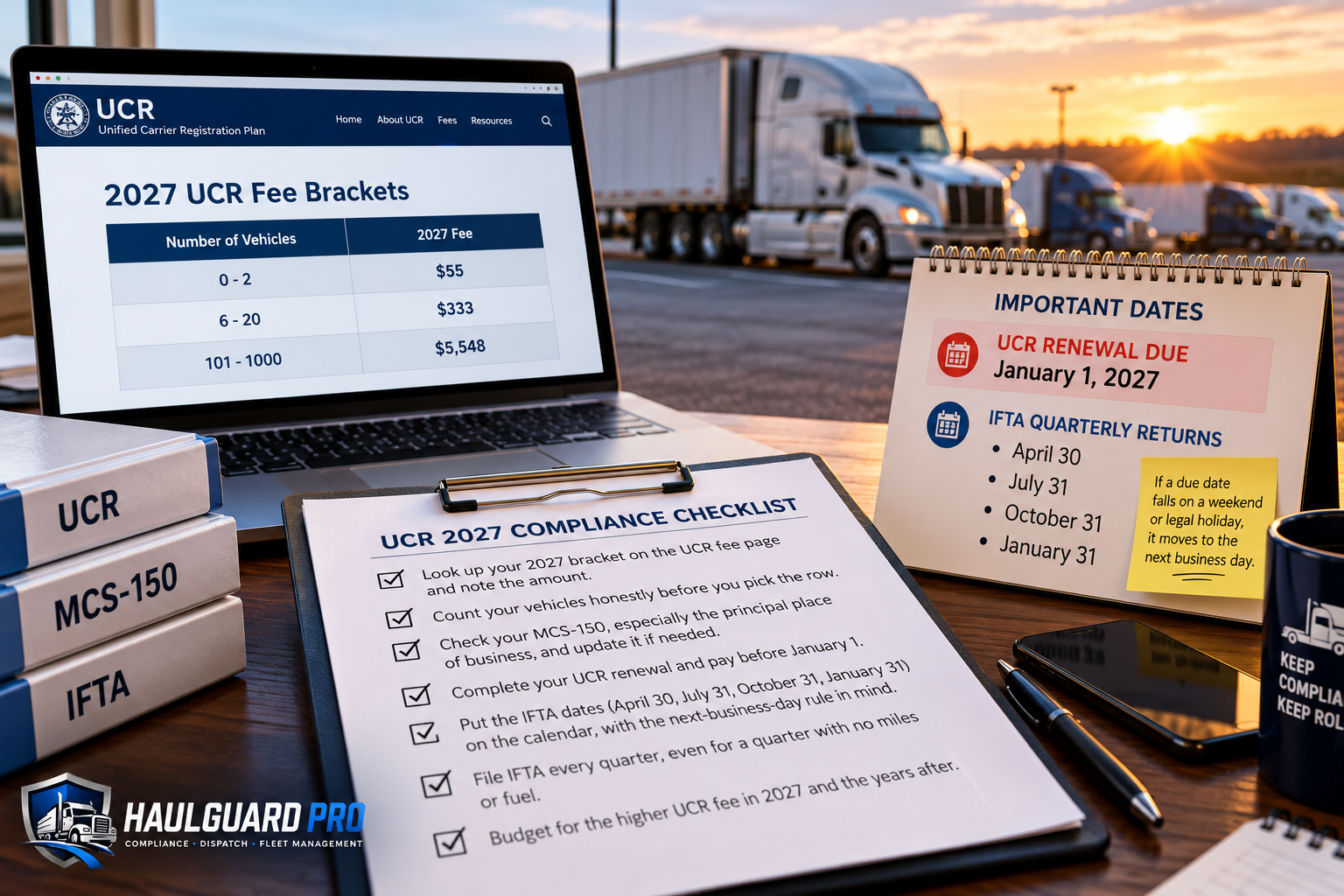
The UCR Plan's fee page is the place to look up your bracket. These are the 2027 figures I can confirm from it:
- 0-2 vehicles: $55
- 6-20 vehicles: $333
- 101-1000 vehicles: $5,548
For comparison, the same page lists 2026 fees of $46 at the low end and $44,836 for the 1001+ bracket. So an owner-operator with one or two trucks is looking at a small bump in dollars, while the biggest fleets feel it much harder.
I'm not listing every bracket here on purpose. If your fleet sits between the ones above, go to the fee page and read your own row.
What I would verify before you pay
Some details in the chatter aren't something I can back up from the official pages I checked, so treat them as "confirm first":
- The exact opening date of 2027 registration. Check the UCR Plan site rather than relying on a post.
- The top-of-the-range figure you may have seen quoted for the largest bracket. Read it off the fee page.
- Any "enforcement starts" date. What the UCR Plan states is that you need to complete registration and pay the fee before January 1 of the registration year to keep operating legally. Work to that date.
It takes five minutes, and it beats paying the wrong amount or planning around a date that turns out to be wrong.
Who needs UCR registration
The UCR Act requires motor carriers, leasing companies, freight forwarders and brokers that operate in interstate commerce to register and pay a fee. If that describes your operation, UCR registration isn't optional, even with a single truck. Pennsylvania's PUC has a useful plain-language overview.
If you're not sure whether you count as interstate, don't guess. Ask your state agency or a compliance professional.
When UCR renewal is due
The UCR Plan says an operation subject to UCR must complete registration and pay the fee before January 1 of the registration year to keep operating legally. For 2027, that means getting it done before January 1, 2027, not in the first week of January when the truck is already on the road.
What happens if you miss it? The sources I'm working from say only that you need to be registered and paid before that date to keep operating legally. They don't spell out penalties, so I won't make any up. Check with your state or the UCR Plan for specifics, and the simplest fix is not to find out.
Fix your MCS-150 first
Here's a step people skip. Pennsylvania's PUC strongly urges carriers to update their MCS-150 before filing UCR, because your base state comes from the principal place of business reported on that form. If the address on the MCS-150 is old, your UCR filing can start from the wrong place.
So the order is: check the MCS-150, correct anything outdated, then file UCR.
UCR is not IFTA
Both are yearly-ish headaches that people lump together, but they run on different clocks. UCR is an annual registration and fee. IFTA is a quarterly fuel tax return.
Virginia DMV says IFTA quarterly returns are due April 30, July 31, October 31 and January 31. If a due date lands on a weekend or legal holiday, it moves to the next business day. Note that January 31 falls right after the UCR deadline, so the end of the year is a double-up.
One more thing that catches people. Florida's DHSMV says IFTA returns must be filed every quarter, even if there were no operations or fuel purchases in an IFTA jurisdiction that quarter. A parked truck doesn't mean a skipped return. Those two pages are from specific states, so confirm the details with your own base jurisdiction.
Quick checklist
Whether you run one truck or a bigger shop, good trucking fleet management comes down to dates you can't lose. Fleet compliance management doesn't have to be fancy: a calendar, a folder, and one person who owns it. Fleet management software can hold those reminders if you'd rather not trust memory, but a spreadsheet works too if you actually open it.
- Look up your 2027 bracket on the UCR fee page and note the amount.
- Count your vehicles honestly before you pick the row.
- Check your MCS-150, especially the principal place of business, and update it if needed.
- Complete your UCR renewal and pay before January 1.
- Put the IFTA dates (April 30, July 31, October 31, January 31) on the calendar, with the next-business-day rule in mind.
- File IFTA every quarter, even for a quarter with no miles or fuel.
- Budget for the higher UCR fee in 2027 and the years after.